


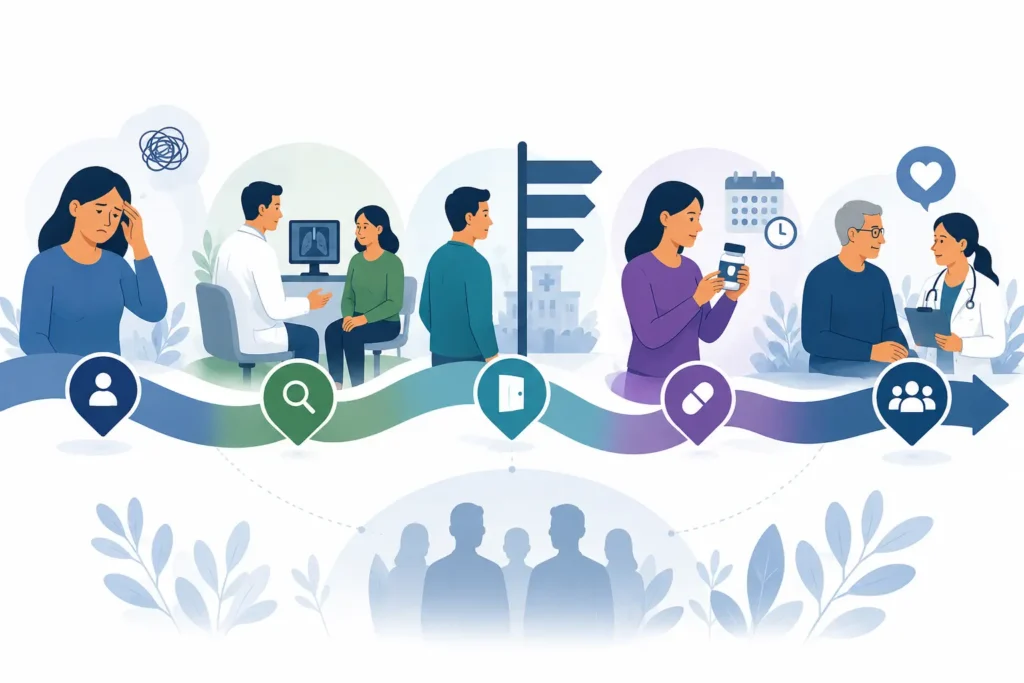
Understanding the patient journey from the first symptoms to diagnosis, treatment, and long-term disease management is essential for pharmaceutical companies developing truly patient-centric strategies. Yet patient journey barriers are rarely uniform. Diagnostic delays, referral gaps, limited treatment access, fragmented care, adherence challenges, and unmet information needs can occur at very different stages depending on the disease, treatment pathway, and healthcare environment. Research also shows that barriers can arise at patient, healthcare professional, and healthcare-system levels, reinforcing the need to understand the specific context in which they occur.
The problem is that applying the same patient pathway framework across different therapeutic areas can hide the barriers that matter most. A patient with a rare or difficult-to-diagnose disease may spend significant time moving between healthcare professionals before receiving the correct diagnosis, while patients with chronic conditions may face greater challenges with treatment persistence and long-term disease management. In specialised care, referral pathways, coordination between stakeholders, and access to appropriate expertise can create additional points of friction. Without understanding these differences, pharmaceutical companies risk investing in initiatives that fail to address the real causes of patient drop-off, delay, or disengagement.
A therapeutic-area-specific approach helps companies identify where these barriers occur, understand why they happen, and determine which interventions can realistically improve the patient experience. This article examines how barriers differ across therapeutic areas and how pharmaceutical companies can identify their root causes, prioritise the most significant challenges, and develop targeted strategies to address them.
What should pharmaceutical companies do to address patient journey barriers?
Pharmaceutical companies should first determine which stages of the patient pathway are most vulnerable within the specific therapeutic area. Rather than starting with a generic journey framework, the analysis should reflect the disease characteristics, diagnostic pathway, treatment setting, specialist involvement, and healthcare environment that shape the patient’s experience. The objective is to understand where patients experience delays, drop-offs, unmet needs, or difficulties moving between stages of care—and, importantly, what causes them.
A strong approach should include:
- Define the strategic objective. Determine whether the priority is improving diagnosis, referral, treatment access, initiation, adherence, follow-up, or long-term disease management.
- Understand the complete care pathway. Effective patient journey mapping can help companies examine how patients move between healthcare professionals, diagnostic services, specialists, treatment centres, and other relevant parts of the healthcare system, while identifying where important barriers or care gaps may occur.
- Identify barriers and their root causes. Distinguish between diagnostic, clinical, informational, behavioural, access-related, and healthcare-system barriers rather than focusing only on where delays occur.
- Integrate the patient perspective. Combining patient experience data with other sources of evidence can generate valuable patient journey insights into symptoms, treatment preferences, quality of life, unmet needs, and aspects of care that may not be visible from clinical evidence alone. EMA recognises the value of both qualitative and quantitative patient experience data throughout medicine development.
- Prioritise the barriers that matter most. Evaluate their impact on patients, frequency, strategic relevance, and whether meaningful intervention is possible.
- Translate insights into action. Connect each priority barrier with relevant stakeholders, targeted interventions, clear responsibilities, and measurable outcomes.
Most importantly, companies should avoid treating patient journey analysis as a one-time mapping exercise. The goal is to build an actionable understanding of the patient pathway that can inform patient-centric strategies and evolve as the therapeutic and healthcare environment changes.
How can Billev Pharma East help address patient journey barriers across therapeutic areas?
Successfully addressing patient journey barriers requires understanding what is driving them within a specific disease and treatment environment. A delay in treatment may originate in disease recognition and diagnosis in one condition, while in another it may be linked to specialist referral, treatment eligibility, healthcare infrastructure, or the complexity of delivering the therapy.
At Billev Pharma East, we help pharmaceutical companies examine barriers within the clinical and healthcare context in which they actually occur. Our multidisciplinary expertise across Medical Affairs, Clinical Research, Regulatory Affairs, Pharmacovigilance, Quality Management, and Health Economics enables us to assess a patient pathway from different perspectives and determine which factors are most relevant to a specific disease and treatment environment.

This becomes particularly important as treatment pathways grow more specialised. In advanced therapies, for example, the patient journey can depend on referral pathways, treatment-centre readiness, eligibility requirements, and highly coordinated clinical and operational processes. In other therapeutic areas, the critical challenge may arise much earlier, around disease recognition or diagnosis, or later during treatment and long-term management.
By bringing the relevant expertise together around the therapeutic area, Billev Pharma East helps companies distinguish between visible barriers and the factors driving them. This creates a stronger basis for deciding where intervention is needed and what type of patient-centric strategy is appropriate—rather than applying the same solution to fundamentally different patient journeys.
Why do patient journey barriers differ by therapeutic area?
Patient journey barriers differ by therapeutic area because each disease creates a distinct combination of diagnostic, clinical, treatment, and healthcare-system challenges. The most important barrier may occur before diagnosis in one therapeutic area, during referral or treatment access in another, and only after treatment initiation in a third.
The first factor to consider is the disease pathway itself. Symptom specificity, disease awareness, availability of diagnostic testing, and the number of healthcare professionals involved can all influence how quickly a patient reaches the correct diagnosis. Referral requirements and access to specialist expertise can add further complexity. Research across different disease areas demonstrates that barriers can arise at very different points, including diagnosis, specialist referral, treatment access, communication, and long-term adherence.
Treatment characteristics are equally important. Companies need to consider where treatment is delivered, how frequently patients interact with healthcare professionals, what level of monitoring is required, and how much burden treatment places on patients and caregivers. Healthcare-system factors such as service availability, waiting times, care coordination, and access can further reshape the journey. WHO similarly emphasises that effective care depends on continuity across prevention, diagnosis, treatment, disease management, and different sites of care.
For pharmaceutical companies, this means that patient journey barriers should always be interpreted within the therapeutic-area context. Understanding where the greatest friction occurs—and what drives it—is the foundation for selecting interventions that address the actual needs of a specific patient population.
How do patient journey barriers compare across therapeutic areas?
The stage at which the greatest friction occurs can therefore differ substantially between therapeutic areas:
| Therapeutic area | Patient journey barriers to examine |
| Rare diseases | Disease recognition, diagnostic delay, misdiagnosis, specialist referral |
| Chronic diseases | Long-term adherence, treatment burden, follow-up, continuity of care |
| Advanced and specialised therapies | Patient identification, eligibility, specialist referral, treatment-centre access |
| Oncology | Diagnostic and treatment transitions, multidisciplinary coordination, access to specialist care |
What are the main patient journey barriers in rare diseases?
In rare diseases, patient journey barriers often emerge long before treatment becomes an option. One of the most significant challenges is reaching an accurate diagnosis. Rare conditions may present with non-specific or heterogeneous symptoms, awareness among healthcare professionals can be limited, and patients may move between multiple specialists and diagnostic procedures before the underlying disease is identified.
The scale of this challenge is substantial. A European Rare Barometer study involving 6,507 people living with 1,675 rare diseases found that the average time between symptom onset and confirmed diagnosis was 4.7 years. Almost three-quarters of respondents had experienced at least one misdiagnosis, while 22% had consulted eight or more healthcare professionals during their search for a diagnosis.
This makes the pre-diagnosis phase a particularly important part of the patient journey in rare disease—one that may require more attention than treatment initiation or long-term management at the earliest stages of analysis.
For pharmaceutical companies, addressing these barriers requires understanding where the diagnostic pathway loses momentum. This may involve examining early symptom recognition, healthcare professional awareness, access to appropriate diagnostic testing, referral patterns, and the point at which patients reach specialist expertise or centres of expertise.
The implications extend beyond diagnosis. A delayed or incorrect diagnosis can postpone access to appropriate care and treatment and may expose patients to unnecessary investigations or interventions. Companies operating in rare diseases should therefore examine the journey from the earliest signs of disease—not only from the point at which a patient becomes eligible for therapy.
Addressing these patient journey barriers may require earlier disease recognition, better-informed referral pathways, improved access to diagnostics, and stronger connections between general and specialist care.
What are the main patient journey barriers in chronic diseases?
In chronic diseases, patient journey barriers often become more prominent after diagnosis and treatment initiation. Unlike conditions where reaching the correct diagnosis is the primary challenge, chronic diseases require patients to remain engaged with treatment, monitoring, healthcare professionals, and self-management over extended periods of time. The critical friction point therefore often shifts from reaching treatment to remaining successfully engaged with treatment and disease management over time.
This makes persistence and adherence particularly important. Long-term treatment can be affected by complex medication regimens, side effects, treatment burden, limited understanding of the disease, difficulties incorporating treatment into everyday routines, and insufficient communication or follow-up. Evidence shows that medication adherence in chronic disease is influenced by multiple interacting factors related to the patient, therapy, condition, healthcare system, and wider socioeconomic environment.
For pharmaceutical companies, the critical question is therefore not only whether patients can access treatment, but what makes it difficult for them to continue managing their condition over time. A patient may successfully initiate therapy but later disengage because the treatment becomes difficult to integrate into daily life, expectations are unclear, follow-up is insufficient, or changing needs are not recognised.
Addressing these patient journey barriers requires companies to look beyond individual treatment decisions and understand the long-term experience of living with a chronic condition. Patient education, treatment expectations, everyday treatment burden, healthcare professional communication, follow-up, and continuity of care should all be considered when determining where meaningful support may be needed.
What are the main patient journey barriers in advanced and specialised therapies?
In advanced and specialised therapies, patient journey barriers often arise from the complexity of reaching and navigating highly specialised treatment. For some advanced therapy medicinal products (ATMPs), including cell and gene therapies, the pathway may involve specialist referral, eligibility assessment, access to qualified treatment centres, complex treatment preparation, and close coordination between multiple healthcare stakeholders. These requirements can create additional points of friction even after a patient has received the correct diagnosis.
Access to specialised centres is particularly important. Some advanced therapies require specific clinical settings, infrastructure, expertise, and capabilities for treatment administration and patient monitoring. This can create geographical and organisational barriers for patients who do not live close to an appropriate treatment centre. Research on ATMP access in Europe has highlighted differences in availability as well as challenges associated with complex manufacturing, distribution, administration, and healthcare infrastructure.
For pharmaceutical companies, the critical question is therefore not simply whether an appropriate therapy exists, but whether eligible patients can successfully progress from identification and referral to treatment. Companies should examine where patients may be delayed or lost between these stages, whether referral pathways are sufficiently clear, and whether the relevant healthcare settings are prepared to support the treatment pathway.
Addressing these patient journey barriers requires an understanding of the entire treatment ecosystem. Patient identification, referral networks, treatment-centre access, eligibility requirements, coordination between healthcare professionals, and long-term follow-up may all need to be considered when determining where targeted support can improve the pathway.
How should pharmaceutical companies prioritise patient journey barriers?
Not every patient journey barrier has the same impact, and attempting to address every identified challenge at once can dilute resources and make it difficult to achieve meaningful change. Pharmaceutical companies therefore need a clear method for determining which barriers require the greatest attention within a specific therapeutic area.
Prioritisation should begin with patient impact. Companies should assess whether a barrier delays diagnosis, prevents referral, restricts access to appropriate treatment, contributes to treatment discontinuation, or creates a significant burden for patients and caregivers. The frequency of the barrier should also be considered alongside its severity, as a recurring friction point may affect a substantial proportion of the patient population even when its individual impact appears moderate.
The next consideration is the underlying cause. A similar outcome can result from very different problems. Delayed treatment, for example, may originate from limited disease recognition, an inefficient referral pathway, insufficient specialist capacity, access restrictions, or patient concerns. Understanding what drives the barrier is essential before deciding how it should be addressed.
Companies should also consider whether the barrier can realistically be influenced and which stakeholders would need to be involved. This helps distinguish between areas where targeted intervention could create measurable improvement and broader systemic challenges that require a different approach.
Ultimately, prioritisation should focus on the intersection between patient need, barrier impact, root cause, and opportunity for intervention. This prioritisation can also support more focused patient journey optimization by helping companies direct attention and resources towards the points in the pathway where meaningful improvement is most achievable.
Address patient journey barriers with the right therapeutic-area strategy
There is no universal solution to patient journey barriers. Their causes, impact, and priority can change significantly between therapeutic areas, making a disease-specific understanding essential before deciding where and how to intervene.
For pharmaceutical companies, the opportunity lies in identifying the barriers that have the greatest impact within a particular patient population and focusing resources where meaningful improvement is possible. This creates a stronger foundation for more relevant patient-centric initiatives and better-informed strategic decisions.
At Billev Pharma East, we bring together multidisciplinary expertise to help pharmaceutical companies understand patient journey barriers within the context of their therapeutic area and translate those insights into focused strategic priorities. If your organisation needs a clearer understanding of where patients encounter the greatest friction and which challenges should be addressed first, our experts can help develop an approach tailored to your disease area, treatment pathway, and strategic objectives.
Sources: 1 – European Medicines Agency (EMA). (n.d.). Multidisciplinary guidelines: Patient experience data (PED), 2 – World Health Organization (WHO). (n.d.). Integrated people-centred care, 3 – Faye F., et al. (2024). Time to diagnosis and determinants of diagnostic delays of people living with a rare disease: Results of a Rare Barometer retrospective patient survey. European Journal of Human Genetics, 32, 1116–1126, 4 – Kvarnström, K., Westerholm, A., Airaksinen, M., & Liira, H. (2021). Factors contributing to medication adherence in patients with a chronic condition: A scoping review of qualitative research. Pharmaceutics, 13(7), 1100, 5 – Čechova Z., et al. (2025). Beyond reimbursement status: Availability of Advanced Therapy Medicinal Products across the European Union.
Image source: AI-generated with ChatGPT (OpenAI)